Grip Strength: The Hidden Indicator of Biological Aging
More Than Just a Handshake: The "Vital Sign" You Are Ignoring
When you visit a doctor, they check your blood pressure, heart rate, and weight. But there is a critical test missing from most standard check-ups: The Grip Strength Test.
For decades, a firm grip was seen merely as a sign of having strong hands or working a manual job. However, groundbreaking research over the last 15 years has completely shifted this paradigm. Today, longevity experts and geriatricians refer to grip strength as an "indispensable biomarker" of aging.
Why? Because your ability to squeeze a dynamometer isn't just about the muscles in your hand; it is a proxy for your overall neuromuscular integrity. It reflects the health of your nervous system, your muscle mass retention (sarcopenia risk), and even your cardiovascular resilience.

In this comprehensive guide, we will explore the science connecting your hands to your lifespan, how to measure your own "biological age" via your grip, and actionable ways to build a grip of steel.
The Science: Why Grip Strength Predicts Mortality
The statistics are startling. A major study published in The Lancet, which followed nearly 140,000 adults across 17 countries, found that grip strength was a better predictor of all-cause mortality than systolic blood pressure.
1. The "Sarcopenia" Alarm System
As we age, we naturally lose muscle mass—a process called sarcopenia. However, this loss doesn't happen evenly. It often shows up in the grip first. A weak grip is the "canary in the coal mine," signaling that your body is losing muscle mass faster than it should.
Check your muscle mass status: Use our FFMI (Fat-Free Mass Index) Calculator to see if your muscle levels are healthy for your height.
2. Neurological Efficiency
Generating force requires your brain to send a strong signal through your nervous system to your muscles. A decline in grip strength often precedes cognitive decline. It indicates that the neural drive—the connection between brain and body—is weakening.
3. Cardiovascular Correlation
Surprisingly, grip strength correlates with heart health. Stronger muscles release myokines (anti-inflammatory molecules) that protect the heart. Weak grip has been linked to arterial stiffness and higher cardiovascular risk.
Monitor your heart: Pair your grip training with regular checks using our Heart Rate Zone Calculator.
Measuring Your "Grip Age"
So, how strong should you be? Grip strength is measured using a device called a Handheld Dynamometer. It measures force in kilograms or pounds.
Average norms vary significantly by age and gender. For example:
- Men (30-35 years): Average is ~45-50 kg.
- Women (30-35 years): Average is ~28-32 kg.
If you are a 40-year-old man with the grip strength of an average 70-year-old, your Biological Age is likely higher than your chronological age. This means you are aging faster than you should.
Find Your Percentile Now
Do not guess where you stand. If you have access to a dynamometer (most gyms have one), test yourself and use our dedicated tool to find your exact biological age correlation.
👉 Go to the Grip Strength Calculator
Also, check your overall Biological Age Calculator for a complete holistic assessment.
Factors That Kill Your Grip
Why might your grip be weak? It is not always about lack of exercise.
- Nutritional Deficiencies: Muscles need fuel. Low protein intake or deficiencies in Vitamin D and Magnesium can cause muscle weakness. (Check your Vitamin Risks and Protein Needs).
- Chronic Inflammation: Systemic inflammation (often from stress or poor diet) attacks muscle tissue.
- Poor Recovery: Grip strength is essentially a neural output. If your central nervous system is fried from lack of sleep, your grip will be weak. (Calculate your Sleep Debt).
How to Build a "Longevity Grip": 3 Types of Strength
You don't need to become a competitive powerlifter to improve your grip. You need to focus on three specific types of hand strength.
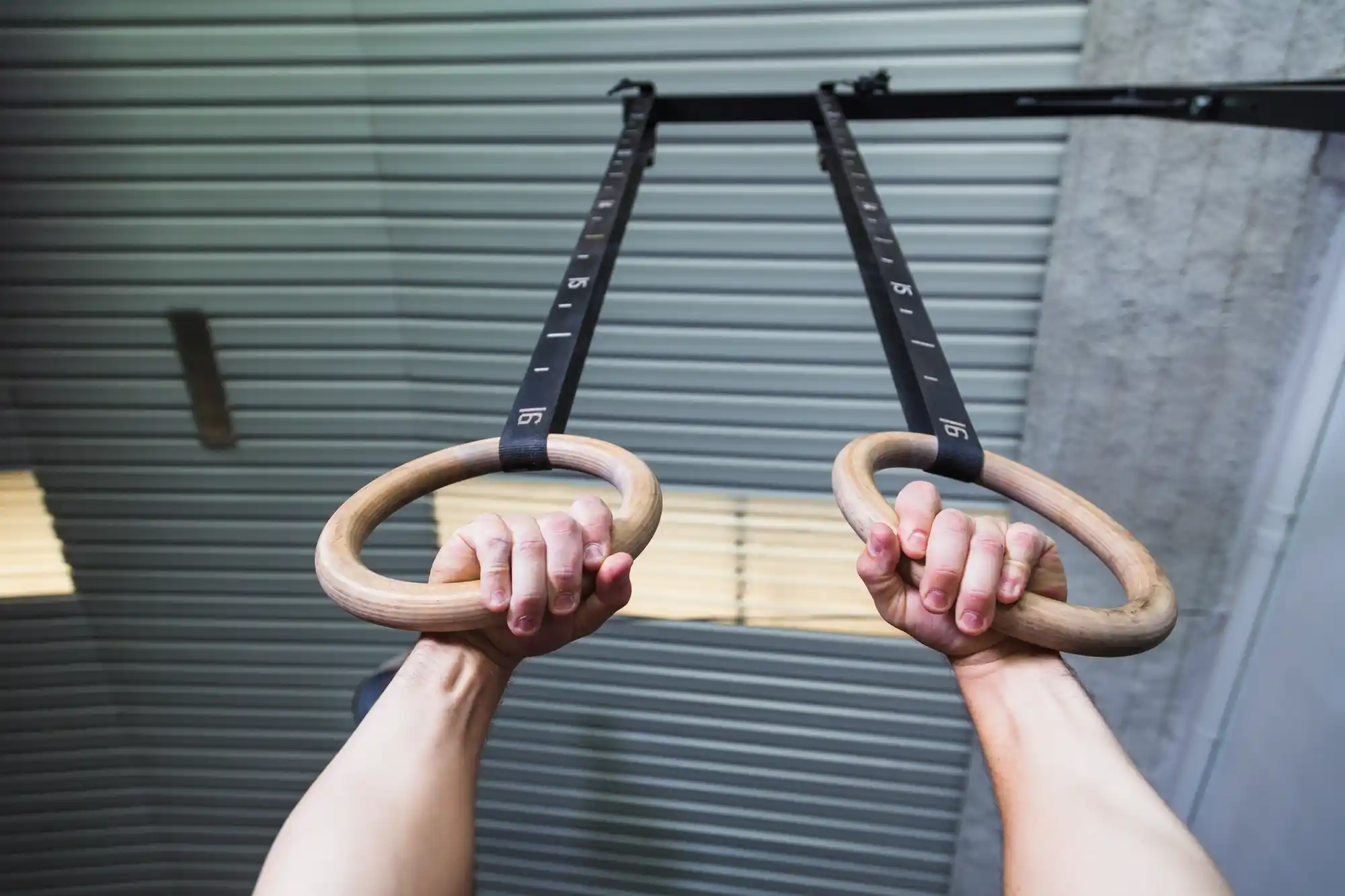
1. Support Grip (The "Hang")
This is the ability to hold onto something for time. As shown in the image above, hanging from a bar or rings is the ultimate test.
The Protocol: Perform "Dead Hangs." Grab a pull-up bar and hang with straight arms. Aim for 60 seconds. This decompresses the spine (great for posture) and builds immense endurance in the forearms.
2. Crushing Grip (The "Handshake")
This is what you use when you squeeze a dynamometer or shake a hand. It relies on the fingers closing against the palm.
The Protocol: Use hand grippers (as seen in the first image). Do not just mindlessly click them. Squeeze fully, hold for 2 seconds, and release slowly. 3 sets of 10-15 reps is excellent.
3. Pinch Grip (The "Fine Motor")
This is the strength of your thumb opposing your fingers. It is often the weakest link.
The Protocol: "Plate Pinches." Hold two smooth weight plates together (smooth side out) and hold them by pinching them with your fingers and thumb. Walk for distance (Farmer's Carries).
A Warning: Grip Strength vs. Neural Fatigue
Interestingly, your grip strength is also a daily bio-marker for your recovery. Many athletes test their grip every morning.
- Baseline: Your normal strength.
- +5-10%: Your nervous system is primed. Great day to go for a Personal Best (1RM).
- -10% or more: Your Central Nervous System (CNS) is fatigued. You are likely under-recovered. Skip the heavy workout and focus on sleep or active recovery.
Use our 1 Rep Max Calculator to plan your training, but let your grip dictate the intensity.
Conclusion: Get a Grip on Your Life
Your hands are your interface with the world. A weak grip makes daily tasks harder, signaling a body in decline. A strong grip signals a robust, capable, and resilient body.
Start small. Buy a gripper for your desk. Hang from a bar when you pass a park. Carry your groceries in one trip. These small acts of strength accumulate, adding not just life to your years, but years to your life.
Your Strength Toolkit
Assess and improve your physical resilience:
- Grip Strength Calculator - Measure your biological age.
- FFMI Calculator - Track lean muscle mass.
- Biological Age Test - The big picture.
- Protein Calculator - Fuel your gains.