Best Times to Wake Up Based on Sleep Cycles: The Scientific Guide to Beating Morning Grogginess
The "8-Hour Myth": Why You Still Wake Up Tired
It is the most common frustration in modern life: You did everything right. You went to bed early. You got a full eight hours of sleep. Yet, when the alarm goes off, you feel groggy, disoriented, and physically heavy. It feels like you haven't slept at all.
Why does this happen? The answer lies in biology, not arithmetic.
Treating sleep as a simple bank account where you just "deposit hours" is a fundamental misunderstanding of human physiology. Your brain doesn't sleep in a straight line; it moves through distinct, rhythmic waves called Sleep Cycles. Waking up in the middle of the wrong cycle—even after 10 hours of sleep—can leave you feeling worse than if you had slept less but woke up at the right moment.
This is the science of Sleep Inertia, and mastering it is the key to waking up refreshed. Before we dive into the deep science, you can instantly find your optimal wake-up times using our Sleep Cycle Calculator.
The Architecture of Sleep: Understanding the 90-Minute Wave
When you close your eyes, your brain begins a journey through four distinct stages. One complete trip through these stages takes approximately 90 minutes. An average night consists of 5 to 6 of these cycles.

Stage 1: The Drift (NREM 1)
This is the bridge between wakefulness and sleep. It lasts only 5-10 minutes. Your muscles relax (sometimes causing a "falling" sensation), and brain waves slow down. Waking up from this stage is easy and painless.
Stage 2: Light Sleep (NREM 2)
Your body temperature drops, and your heart rate slows. This is where your body begins to conserve energy. You spend about 50% of your night in this stage. It serves as a buffer before the deep dive.
Stage 3: Deep Sleep (NREM 3 / Slow Wave Sleep)
This is the critical zone. This is the physically restorative stage where tissue repair happens, growth hormones are released, and the immune system recharges. Your brain waves are extremely slow (delta waves).
The Danger Zone: If your alarm goes off while you are in Stage 3, you will experience severe Sleep Inertia. Your brain is essentially "drunk" on sleep. You will feel confused, heavy, and extremely groggy. This is exactly what we want to avoid.
Stage 4: REM Sleep (Rapid Eye Movement)
This is where the magic of the mind happens. Your brain becomes highly active (almost as active as when you are awake), and you dream. REM is essential for emotional regulation, memory consolidation, and learning. Interestingly, your voluntary muscles are paralyzed during this stage to prevent you from acting out your dreams.
The Math of Waking Up Refreshed
The secret to a perfect morning is simple: Wake up at the end of a cycle, not in the middle of one.
Since one cycle is roughly 90 minutes, you want to time your sleep in multiples of 90 minutes. Here is the breakdown:
- 4 Cycles: 6.0 Hours (Passable)
- 5 Cycles: 7.5 Hours (Optimal for most)
- 6 Cycles: 9.0 Hours (Excellent for athletes/recovery)
Notice that "8 hours" is not on this list. Sleeping for exactly 8 hours often means waking up right in the middle of a Deep Sleep phase (Stage 3), which guarantees grogginess. Sleeping 7.5 hours is often better than sleeping 8 hours.
To do this math instantly without counting on your fingers, check our Sleep Cycle Calculator.
The Enemies of Your Sleep Cycle
Even if you time your alarm perfectly, certain factors can fracture your sleep cycles, preventing you from ever reaching Deep Sleep or REM. This results in "junk sleep."
1. Alcohol and the "Rebound" Effect
Many people use a "nightcap" to fall asleep. While alcohol sedates you (helping you reach Stage 1 faster), it aggressively suppresses REM sleep. As the alcohol wears off, your body experiences a glutamate rebound, often waking you up in the middle of the night.
If you have been drinking, your sleep architecture is already compromised. You can calculate your recovery time using our Hangover Recovery Calculator to understand when your body will clear the toxins.
2. Thermal Regulation (Body Temperature)
For your body to enter Deep Sleep (Stage 3), your core body temperature must drop. If your room is too hot, or your metabolism is firing from a late meal, this drop cannot happen.
This is where metabolic rate plays a role. Eating a heavy meal right before bed keeps your BMR (Basal Metabolic Rate) high, generating heat and digestion energy that disrupts the cycle. Check your metabolic needs with our BMR Calculator to plan your meals better.
3. Hydration Balance
Dehydration causes snoring and dry mouth, disrupting sleep. Conversely, drinking too much water right before bed causes nocturia (waking up to urinate), which resets your 90-minute timer back to zero. Finding the balance is key. Use our Daily Water Intake Calculator to ensure you hydrate during the day, not just before bed.
Physical Optimization: Posture and Environment
Timing is 50% of the equation. The other 50% is your physical environment. You cannot complete a healthy sleep cycle if you are in physical pain or discomfort.
The Importance of Spinal Alignment
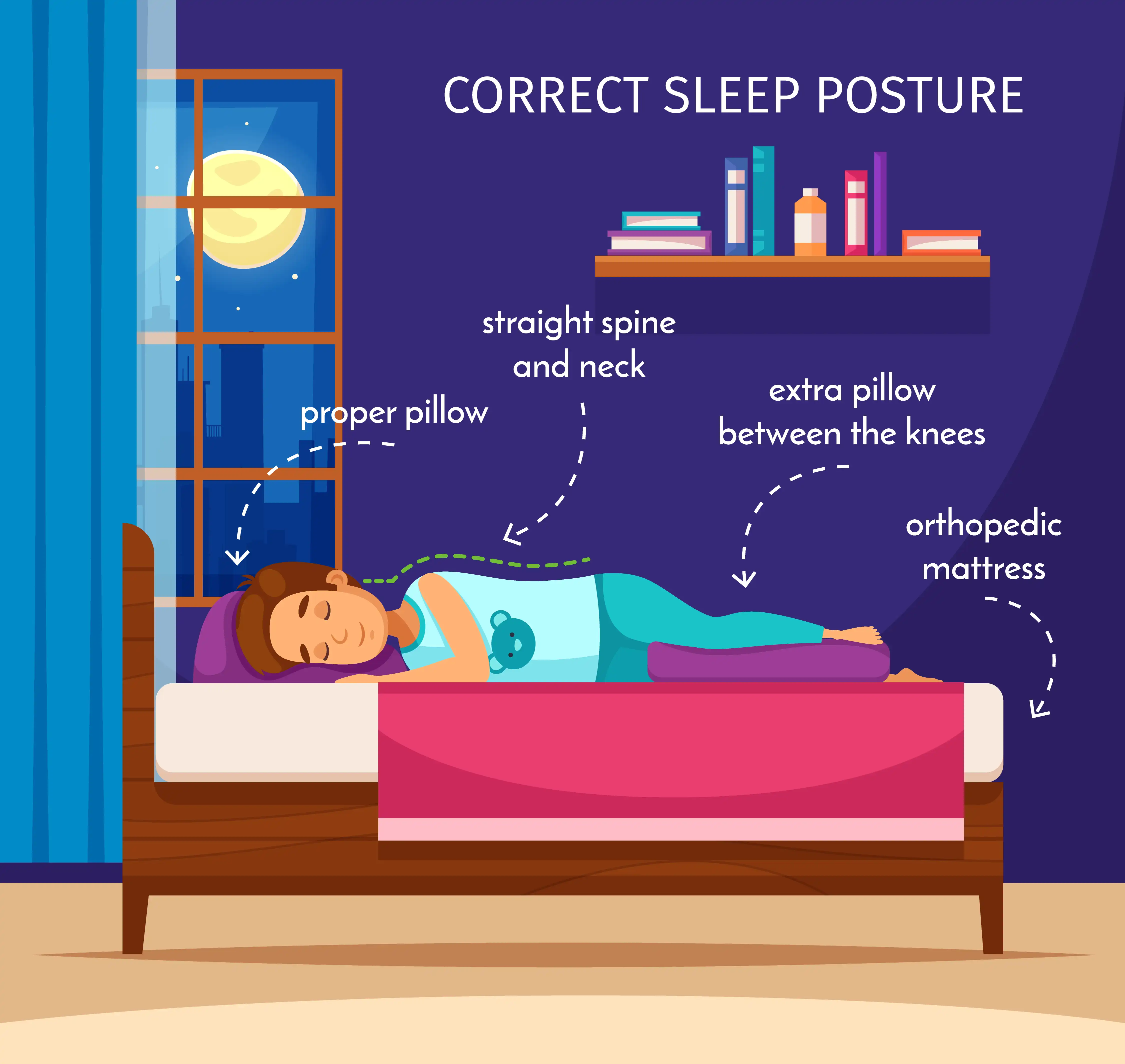
As shown in the diagram above, your sleep posture dictates your breathing and spinal health.
- Back Sleepers: Often the best for spinal alignment, but can worsen snoring or sleep apnea. A thin pillow is usually best.
- Side Sleepers: The most common position. As illustrated, placing a pillow between your knees is crucial to keep your hips aligned and reduce lower back strain. This allows the nervous system to relax fully, facilitating the transition into Deep Sleep.
- Stomach Sleepers: Generally not recommended as it strains the neck and spine.
Heart Rate and Sleep Quality
Your Resting Heart Rate (RHR) should dip significantly during sleep. If your RHR remains high overnight, it's a sign that your body is not entering the restorative stages of the cycle. This could be due to stress, overtraining, or late caffeine intake.
Monitoring your heart rate trends is a great way to gauge sleep quality. You can learn more about healthy zones with our Heart Rate Zone Calculator.
How to Calculate Your Wake-Up Time Manually
If you don't have our calculator handy, here is the manual formula:
- Determine your Wake-Up Time: (e.g., 7:00 AM).
- Count Backwards in 90-minute increments:
- 7:00 AM minus 90 min = 5:30 AM
- minus 90 min = 4:00 AM
- minus 90 min = 2:30 AM
- minus 90 min = 1:00 AM
- minus 90 min = 11:30 PM
- minus 90 min = 10:00 PM
- Add "Fall Asleep" Time: The average human takes 14 minutes to fall asleep. So, if you aim for the 10:00 PM slot, you should be in bed by 9:45 PM.
This math can get tricky, especially when you are tired. That is why we built the tool.
Conclusion: Quality Over Quantity
The "hustle culture" often treats sleep as a waste of time, or something to be minimized. But science tells us that sleep is the foundation of every other biological process. By shifting your focus from "how many hours" to "how many cycles," you can hack your biology to wake up feeling energized, alert, and ready to dominate your day.
Stop guessing and stop suffering through the morning grogginess. Find your perfect bedtime right now with the Sleep Cycle Calculator.