How to Fix Your Sleep Schedule Quickly: The Science-Backed Reset Guide
The 3 AM Insomnia Club: Why You Can't Just "Go to Bed Early"
It starts innocently enough. Maybe you stayed up late one weekend to binge-watch a show, or you had a deadline that pushed you into the early morning hours. But now, it is Sunday night, and your body is wide awake at 2 AM, dreading the Monday morning alarm.
This is called Delayed Sleep Phase Syndrome (DSPS), or more commonly, a messed-up body clock. The common advice—"just go to bed earlier"—rarely works because your internal biology is fighting against you. Your body temperature, cortisol, and melatonin production are all synced to the wrong time zone.

In this comprehensive guide, we will ditch the old wives' tales and use neuroscience to reset your circadian rhythm. We will explore light therapy, the "fasting hack," and the precise timing you need to fix your sleep schedule quickly—without pulling a painful all-nighter.
The Machinery: How Your Circadian Rhythm Actually Works
To fix the machine, you need to understand the gears. Your "Master Clock" is a tiny bundle of neurons in the brain called the Suprachiasmatic Nucleus (SCN). It controls when you feel sleepy and when you feel alert.
The SCN is regulated by external cues called Zeitgebers (German for "Time Givers"). The two most powerful Zeitgebers are:
- Light: The strongest signal. Blue light tells the SCN it is "Day," while darkness signals "Night."
- Food: A secondary but powerful signal. Eating tells your body to be awake and metabolically active.
When you stare at your phone at midnight (Blue Light) and eat a snack at 1 AM (Food), you are forcefully telling your SCN that midnight is actually "noon." No wonder you can't sleep.
Are Your Screens Sabotaging You?
Blue light suppresses melatonin production for hours. Are you using "Night Shift" mode, or is it not enough? Check your digital eye strain and risk level with our Screen Time Calculator.
Strategy 1: The "Harvard Fasting Hack" (The Nuclear Option)
Researchers at Harvard Medical School discovered that while light adjusts the clock gradually, food can reset it rapidly. This is based on an evolutionary survival mechanism: if an animal is starving, it must stay awake to hunt, overriding the sleep clock.
The Protocol: To reset your clock effectively, stop eating for 12-16 hours before the time you want to wake up.
- Goal: You want to wake up at 7:00 AM.
- The Fast: Stop eating at 3:00 PM or 4:00 PM the day before.
- The Reset: Do not eat a single calorie until 7:00 AM the next morning.
- The Result: When you break the fast with a big, protein-rich breakfast at 7:00 AM, your body thinks, "Ah, food! This must be the start of the day!" It resets your metabolic clock to that specific time.
Strategy 2: The Light & Dark Protocol
This is the gold standard for fixing your schedule long-term. You must manipulate light exposure with military precision.
Morning: The "Light Shower"
Within 30 minutes of waking up (even if you are tired), you must get bright light into your eyes. Sunlight is best (10,000+ lux). If it is dark, turn on every light in the house.
Why? This triggers a cortisol spike that clears out the "sleepy" chemical (adenosine) and starts a 12-14 hour timer for melatonin release later that night.
Night: The "Digital Sunset"
After sunset, your environment should mimic a cave. Dim the lights. Use amber-tinted glasses.
The Critical Error: One notification can ruin this. Checking your phone at 10 PM hits your retina with blue light, pushing your sleep window back by 30-60 minutes. Calculate exactly when you need to shut down with our Sleep Cycle Calculator.
Strategy 3: The Caffeine Cut-off Rule
You might think your afternoon coffee helps you power through the grogginess, but it is actually the reason you can't fall asleep at your new bedtime.
Caffeine has a half-life of 5-6 hours. This means if you drink a double espresso (200mg) at 4:00 PM, you still have 100mg in your system at 10:00 PM. That is equivalent to drinking a cup of coffee right before bed.
The Fix: You need a strict cut-off time based on your physiology.
Tool: Use our Caffeine Cut-off Calculator to find your exact "last cup" time based on your target bedtime.
Why You Should NEVER Pull an "All-Nighter"
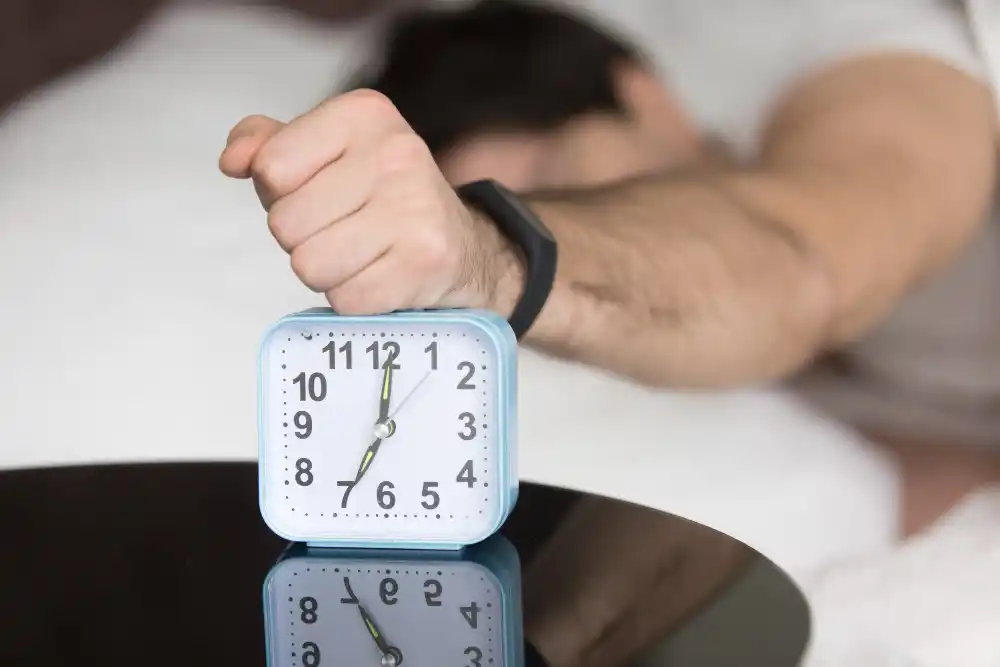
The most common advice for fixing a sleep schedule is: "Just stay up all night and go to bed early the next day." Do not do this.
Staying awake for 24 hours creates massive "Sleep Debt." When you finally go to sleep the next night, your body will rebound into an abnormally deep sleep, often causing you to oversleep the next morning, leaving you right back where you started (but with more brain fog).
Instead, try to sleep for 3-4 hours during your "old" sleep time, force yourself up, and then use the Fasting and Light protocols to shift the next night.
Check your debt: Use our Sleep Debt Calculator to see how far behind you really are.
The Ultimate 24-Hour Reset Plan
Ready to fix it? Here is your step-by-step itinerary for tomorrow.
The Reset Itinerary
- 07:00 AM: WAKE UP. Do not hit snooze. Get out of bed immediately.
- 07:05 AM: Get sunlight. Go outside for 10 minutes or stare out a window. Do 10 jumping jacks to get heart rate up.
- 07:30 AM: Break your fast (if using the Fasting Hack). Eat a high-protein breakfast.
- 10:00 AM: If you drink caffeine, have it now.
- 02:00 PM: Last call for caffeine. No more coffee, tea, or soda.
- 04:00 PM: The "Slump." Do not nap. If you must nap, keep it to 20 minutes max.
- 07:00 PM: Exercise lightly. A walk or light weights. This raises body temp slightly, which will drop later, signaling sleep.
- 09:00 PM: Digital Sunset. Phone away. Blue light blockers on.
- 10:00 PM: Take a hot shower. The cooling effect afterwards mimics the natural body temp drop of sleep.
- 10:30 PM: Bed. Read a physical book (no screens).
Supplements: Melatonin as a Tool, Not a Crutch
Melatonin is not a sleeping pill; it is a "darkness signaler." If your body thinks it is 4 PM but you want to sleep at 10 PM, a small dose of melatonin (0.5mg - 3mg) can help shift your circadian phase.
However, timing is everything. Take it 2 hours before your target bedtime, not right as you get into bed. This mimics the natural rise of the hormone.
Traveling? If your schedule issues are due to travel, use our Jet Lag Recovery Calculator for a specific plan.
Conclusion: Consistency is King
Fixing your sleep schedule is not a one-night event; it is a lifestyle adjustment. Once you reset your clock, protect it. Keep your wake-up time consistent, even on weekends. Your brain craves routine.
Don't let another day vanish into brain fog. Set your alarm, put down the coffee, and reclaim your mornings.
Your Sleep Toolkit
Master your rest with these free tools:
- Sleep Cycle Calculator - Wake up refreshed.
- Caffeine Calculator - Protect your sleep.
- Screen Time Calculator - Manage blue light.
- Jet Lag Calculator - Travel smarter.