Safe Tanning Guide: Calculating Your UV Limit Before Burn & The Science of SPF
The Fine Line Between "Sunkissed" and "Sun-Damaged"
Summer arrives, and with it comes the universal desire for that golden, healthy glow. We equate a tan with vitality, health, and a life well-lived outdoors. But biologically, a tan is something else entirely: it is your skin's desperate attempt to protect itself from DNA damage.
Every year, millions of people head to the beach with a vague plan—"I'll just stay out until I get some color." This guesswork is dangerous. The difference between stimulating Vitamin D production and causing irreversible cellular damage can be a matter of minutes, depending on the invisible force known as the UV Index.
In this comprehensive guide, we will ditch the guesswork. We will explore the physics of sunlight, teach you how to identify your specific skin type (Fitzpatrick Scale), and show you how to use mathematics—not just feeling—to tan safely.
The Physics of Light: UVA vs. UVB
Sunlight isn't just "heat." It is radiation. To tan safely, you must understand the two main types of ultraviolet rays reaching your skin:
1. UVA (The "Aging" Rays)
UVA rays penetrate deep into the dermis (the skin's thickest layer). They are responsible for:
- Immediate tanning (oxidizing existing melanin).
- Premature aging (wrinkles, leathery texture).
- Destroying collagen and elastin.
Think "A" for Aging. These rays are present with relatively equal intensity all day and can penetrate glass and clouds.
2. UVB (The "Burning" Rays)
UVB rays hit the superficial layers (epidermis). They are responsible for:
- Delayed tanning (stimulating new melanin production).
- Sunburns (Erythema).
- Most skin cancers.
Think "B" for Burning. These rays vary by time of day and season.
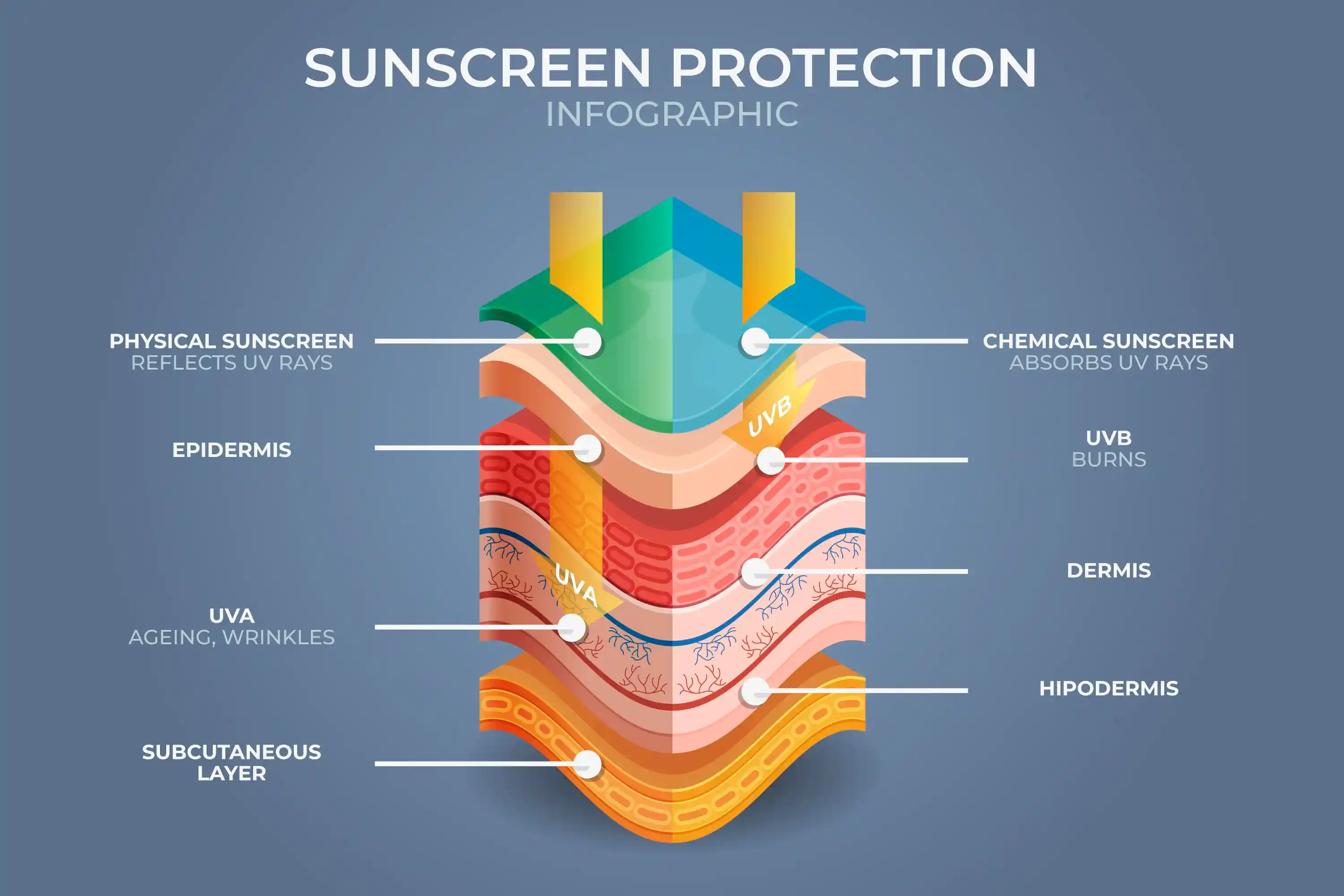
As shown in the infographic above, protecting your skin requires a multi-layered approach. Without protection, UVB rays burn the surface, while UVA rays silently destroy the foundation.
The Hidden Cost: Biological Aging
Up to 80% of visible facial aging is caused by UV exposure, not genetics. A tan might look good today, but it accelerates your biological clock. Curious how your lifestyle is aging you? Take the test:
Know Your Skin: The Fitzpatrick Scale
You cannot calculate your safe tanning time without knowing your variable in the equation. Dermatologists use the Fitzpatrick Skin Type Scale to classify how skin reacts to UV.
- Type I: Pale white skin, blue/green eyes, red/blond hair. Always burns, never tans.
- Type II: Fair skin. Burns easily, tans poorly.
- Type III: Darker white skin. Tans after initial burn.
- Type IV: Light brown skin. Burns minimally, tans easily.
- Type V: Brown skin. Rarely burns, tans darkly easily.
- Type VI: Dark brown or black skin. Never burns (though still susceptible to DNA damage).
A Type I individual might burn in 10 minutes at UV Index 6, while a Type IV might last 45 minutes. Understanding this is critical for survival in the sun.
The Math of the Burn: How SPF Actually Works
What does "SPF 30" actually mean? It is a multiplier.
The formula is: Minutes to Burn without Sunscreen × SPF Number = Total Minutes of Protection.
Example: If you (Type II skin) would normally burn in 10 minutes:
- With SPF 15: 10 x 15 = 150 minutes (2.5 hours)
- With SPF 30: 10 x 30 = 300 minutes (5 hours)
- With SPF 50: 10 x 50 = 500 minutes (8+ hours)
However, this is theoretical. In reality, sweating, swimming, and rubbing a towel removes sunscreen, reducing this time by half or more.
Don't Do Math at the Beach
The UV Index changes every hour. Your skin type is fixed. The math is complex. Stop guessing and risking a painful burn.
Use our advanced tool to calculate your exact safe exposure time based on today's UV Index and your skin type:
The Vitamin D Dilemma: Sun is Essential
We've demonized the sun, but we evolved under it. Sunlight is the primary source of Vitamin D, a hormone-like nutrient essential for bone health, immune function, and mood regulation.
The goal is to find the "Goldilocks Zone": Getting enough sun to synthesize Vitamin D, but stopping before erythema (redness/burning) occurs. For most light-skinned people, this is just 10-15 minutes of midday sun. For darker skin, it may take 30-40 minutes.
Are you getting enough? Or are you deficient due to excessive indoor time? Check your risk profile with our Vitamin Deficiency Calculator.
Safe Tanning Protocol: A Step-by-Step Guide
1. Exfoliate Beforehand
Dead skin cells block UV rays unevenly and lead to a patchy tan that flakes off quickly. Exfoliate 24 hours before sun exposure for an even base.
2. Use "Broad Spectrum" Sunscreen
As seen in the infographic, you need protection from both UVA and UVB. Look for "Broad Spectrum" on the label.
- Chemical Sunscreens: Absorb UV rays (like a sponge). Good for sports.
- Physical Sunscreens (Zinc/Titanium): Reflect UV rays (like a mirror). Better for sensitive skin and immediate protection.
3. Time It Right
Avoid the "Solar Noon" (typically 11 AM to 3 PM) if you are looking to tan safely. The UV Index is highest then. Tanning before 11 AM or after 3 PM takes longer, but the risk of burning is significantly lower.
4. The "Shadow Rule"
Look at your shadow. If it is shorter than you are, the sun is high and UV rays are intense (Seek shade). If your shadow is taller than you, UV intensity is lower.
5. Hydrate from the Inside
Sun exposure dehydrates the skin rapidly. Dry skin peels; hydrated skin tans. Drink water constantly.
Tool: How much water do you need in the heat? Calculate it with our Water Intake Calculator.
Aftercare: Locking in the Glow
The damage often happens after you leave the beach. The skin continues to generate heat and inflammation.
- Cool Down: Take a cool (not cold) shower to stop the thermal reaction.
- Moisturize: Use Aloe Vera or lotions with Hyaluronic Acid. Avoid petroleum-based products (like Vaseline) on a fresh burn as they trap heat.
- Repair: Eat antioxidant-rich foods (berries, dark chocolate) to help your body fight the free radicals generated by UV exposure.
Conclusion: Respect the Star
The sun is a nuclear reactor in the sky. It sustains all life, but it demands respect. Tanning is not inherently "safe," but by using science—understanding your skin type, checking the UV index, and calculating your limits—you can enjoy the warmth without paying the price with your health.
Don't guess. Calculate. Your skin will thank you in 20 years.